Joe’s Favorite TOS Episodes

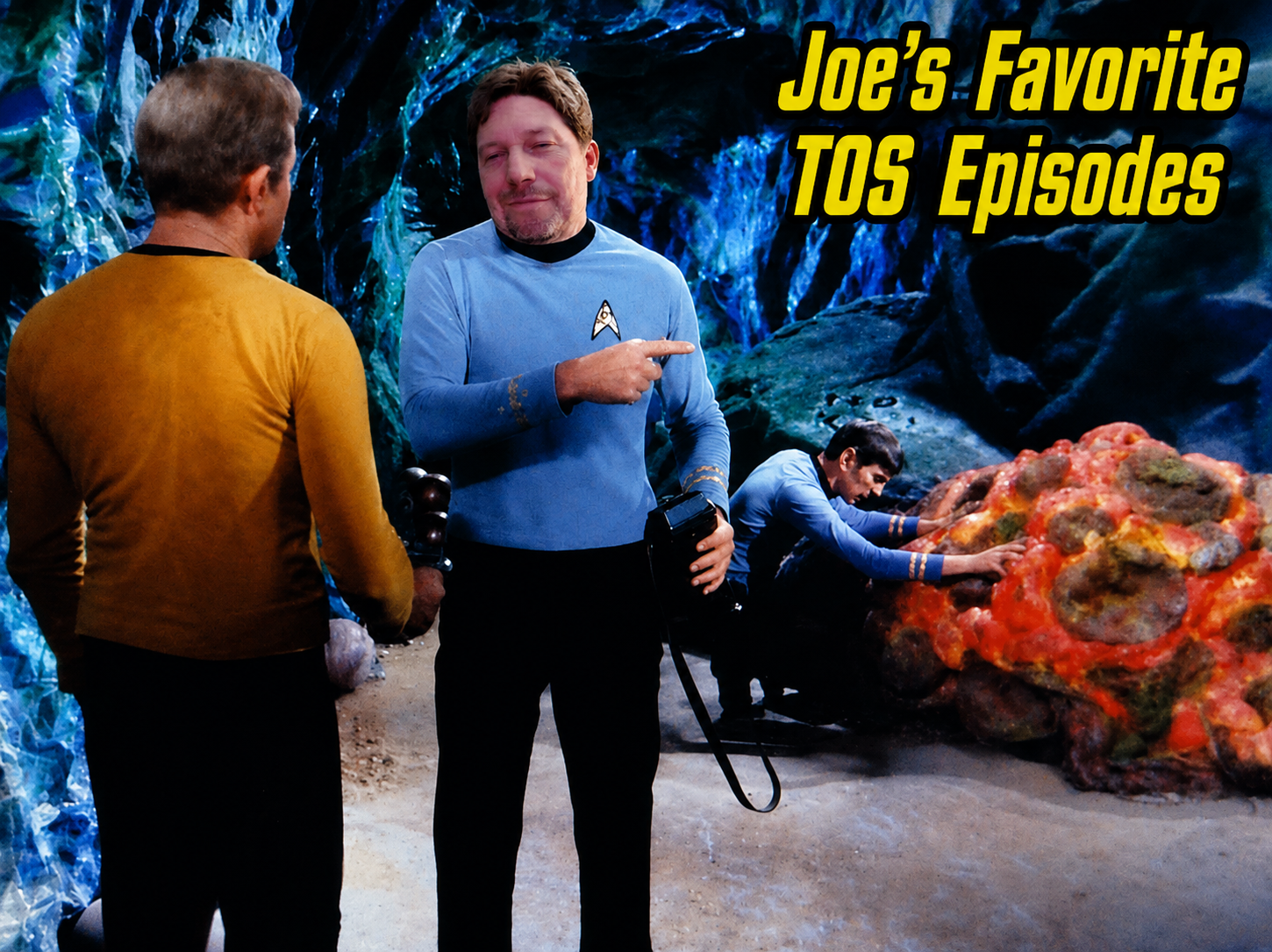
This is not a list of the objectively best episodes of Star Trek: The Original Series.
That list has been done a thousand times. It usually includes the same famous episodes, in roughly the same order, with the same arguments in the comments. This list is different.
This is my list.
These are the TOS episodes that explain why I love Star Trek. Some are legitimately great. Some are goofy. Some have brilliant science-fiction ideas hiding underneath questionable special effects. Some are here because they raise serious moral questions. Some are here because they have ancient computers, androids, dead civilizations, weird props, rare Enterprise sets, or Batman ’66 guest stars.
My list currently has 32 episodes out of 79, so this is not even half the series. I am not saying every episode is essential. I am saying these are the episodes that, for one reason or another, I would still defend, rewatch, or tell someone to notice.
This is a subjective list, but it is not random. I have my nuanced reasons.
1. The Devil in the Dark
McCoy: “I’m a doctor, not a bricklayer.”
This is Star Trek at its best because the title itself becomes part of the twist. At first, everyone assumes the unknown creature in the tunnels must be the devil in the dark. The miners seem justified because something is killing them, destroying equipment, and threatening the whole operation.
Then the episode turns the story around. The Horta is not the devil. She is a wounded mother protecting her eggs. The real “devils in the dark” are the people underground killing what they do not understand. They are not evil in a cartoonish way; they are frightened, angry, and wrong. That makes the twist stronger because we understand why they made the mistake, but we also see how dangerous that mistake became.
That is why this episode is my favorite. It takes fear of the unknown and turns it into compassion, communication, and cooperation. Kirk does not win by destroying the creature. Spock does not win by outsmarting it. McCoy does not win by treating it like a normal patient. They win because they stop long enough to realize the monster was never really the monster.
The real danger was fear acting before understanding.
Horta: “No kill I.”
This is also why the Horta works better for me than the Gorn in “Arena.” Both episodes have the idea that the alien monster may not really be the monster, but the Horta has more emotional power. Pizza monster beats Temu lizard outfit.
2. All Our Yesterdays
Atoz: “I must ask you not to touch the controlling mechanism.”
This one has a great science-fiction idea with real emotional weight. A whole civilization is facing the end of its world, and instead of escaping into space, the people escape into their own past. That is a beautifully strange idea: the planet is dying, but its people survive by scattering themselves backward into earlier eras.
The time library is one of those classic TOS concepts that feels bigger than the episode itself. Mr. Atoz is not just a librarian; he is the last-minute travel agent for an entire doomed civilization. The shelves, disks, and portals all feel very old-school sci-fi, but the idea underneath is strong.
What really lifts the episode is Spock. Once he is sent into Sarpeidon’s past, he begins slipping into a more primitive version of himself. He is still Spock, but not quite the Spock we know. His relationship with Zarabeth gives the story an emotional pull that a simple time-travel adventure would not have.
This episode works because it mixes big science-fiction machinery with personal loss. Sarpeidon is ending. Zarabeth is trapped. Spock is changing. McCoy sees what is happening and tries to pull him back. It is strange, sad, and memorable.
That is exactly the kind of TOS story I like: a wild idea with real feeling underneath it.
3. For the World Is Hollow and I Have Touched the Sky
Oracle: “Then learn what it means to be our enemy before you learn what it means to be our friend.”
A generation ship hidden inside an asteroid is a great classic science-fiction concept. The people of Yonada think they are living on a world, but they are really inside a machine traveling through space. That alone is enough to make the episode memorable.
What makes it better is that the civilization no longer understands the technology that keeps it alive. They live inside an artificial world, obey the Oracle, follow rituals, and treat old computer commands like divine law. It is another strong TOS example of people being trapped by technology they inherited but no longer comprehend.
The Oracle is exactly the kind of ancient computer nonsense I enjoy. It presents itself as sacred authority, but underneath the religious language is a controlling machine that punishes doubt and protects the mission without explaining the truth to the people it supposedly serves.
McCoy’s role gives the episode emotional stakes. His illness, his relationship with Natira, and the possibility that he might choose to stay on Yonada add more weight than the usual “fix the computer and leave” structure. The episode has mystery, romance, danger, and a civilization built around a lie.
That is why this one ranks so high for me. It has one of my favorite Trek patterns: a society living inside a system it no longer understands, while the Enterprise has to uncover the truth before the machinery destroys everyone.
4. Spock’s Brain
Kara: “Brain and brain! What is brain?”
This episode gets mocked constantly, and I understand why. The title is ridiculous. The premise sounds ridiculous. The execution is often ridiculous. But underneath all of that, there is a genuinely good science-fiction idea.
A civilization is completely dependent on technology it no longer understands. The people have inherited comfort, control, and survival from machines, but they have lost the knowledge needed to maintain that world. They do not really understand the Controller. They only know that they need a brain to make the system work.
That is a strong concept. It is goofy on the surface, but the bones of the story are good.
I call this episode “Xbox Brain” because after Spock’s brain is removed, his body is controlled with a push-button remote control. That gives us remote-controlled Spock, which is both absurd and unforgettable. It is exactly the kind of thing people mock, but also exactly the kind of thing that makes TOS stick in your head.
The episode also connects to a recurring Trek idea I like: advanced technology without wisdom. The people in the underground civilization have the benefits of a machine world, but not the understanding. They are not evil masterminds. They are people living inside the remains of a system they cannot truly operate.
So yes, “Spock’s Brain” is silly. But it is not empty. It has lost knowledge, machine dependence, class division, medical weirdness, remote-control Spock, and one of the most famously bizarre lines in the series.
I will defend “Xbox Brain.”
5. Return to Tomorrow
Kirk: “Risk is our business.”
This is one of those big, theatrical TOS episodes where the idea is larger than the sets. Ancient minds are stored in glowing spheres, waiting for a chance to live again. They are not just ghosts, and they are not just aliens. They are the remains of a civilization trying to survive after losing almost everything.
The episode works because the temptation is understandable. Sargon and his people were once incredibly advanced, and their dream of returning through android bodies is not automatically evil. That makes the story more interesting. The danger is not simply that they want to live again; the danger is what they might be willing to do once they remember what having bodies feels like.
Kirk’s “risk is our business” speech is one of the great statements of what Star Trek is. Exploration is dangerous. Trust is dangerous. Contact with the unknown is dangerous. But the whole point of the Enterprise is that humanity has decided the risk is worth taking.
This episode also fits one of my favorite Trek themes: survival without wisdom can become dangerous. Sargon is noble, but Henoch shows how quickly a second chance can turn into possession, manipulation, and power. The story asks whether a civilization deserves to continue if it has to violate others to do it.
That is why I like it. It has ancient beings, borrowed bodies, lost civilization energy, philosophical stakes, and a classic Kirk speech that still explains the mission.
6. The Cloud Minders
Droxine: “I have never before met a Vulcan, sir.”
Spock: “Nor I a work of art, madam.”
This episode has one of the clearest social contrasts in TOS: a beautiful city floating in the clouds while workers suffer in the mines below. It is not subtle, but it does not need to be. The whole point is that privilege can make exploitation look normal to the people benefiting from it.
The cloud city of Stratos looks civilized, refined, and peaceful, but that peace depends on the labor and suffering of the Troglytes. Meanwhile, the people in the mines are treated as if they are naturally inferior, when the real problem is environmental exposure and social control. That makes the episode a direct story about class, inherited assumptions, and the lies people tell themselves to preserve comfort.
It also gives Spock one of his smoothest lines in the entire series. Droxine says she has never met a Vulcan before, and Spock responds like a logical poet. It is formal, elegant, and absolutely flirting, even if he would probably deny it under questioning.
Droxine is beautiful, but her name sounds like it came from a pharmaceutical commercial for a sleeping pill.
Ask your doctor if Droxine is right for you. Do not operate shuttlecraft until you know how Droxine affects you.
That mix is exactly why the episode works for me. It has a real social message, a striking visual contrast, Spock being unexpectedly charming, and just enough TOS oddness to make it memorable.
7. A Taste of Armageddon
Kirk: “We’re human beings with the blood of a million savage years on our hands.”
This is one of the darkest ideas in TOS: a war that has been made clean, orderly, computerized, and socially acceptable. Eminiar VII and Vendikar have not ended war. They have made war efficient. They have removed the visible destruction but kept the death.
That is what makes the episode so disturbing. The buildings still stand. The streets still function. Society continues. But when the computer says you are a casualty, you report to a disintegration chamber and die on schedule. It is death by appointment.
My favorite description for this episode is the Roach Motel version: citizens check in, citizens don’t check out.
The episode is a great “Kirk breaks the system” story because the system deserves to be broken. Eminiar has confused order with morality. They think they have civilized war because the killing is organized, but Kirk sees the truth: sanitized murder is still murder.
There are plenty of operational problems here. The Enterprise gets pulled into a war simulation it never agreed to, Starfleet authority gets messy, Ambassador Fox is reckless, and the ship should have been at red alert long before it was. Instead, TOS gives us a lot of Alert Condition Beige.
But the core idea is so strong that the episode easily stays in my top ten. A society that preserves its buildings by sacrificing its people is one of the most chilling concepts in the series.
8. The Trouble with Tribbles
Cyrano Jones: “My friend, ten credits apiece is a very reasonable price. Now you can see for yourself how much the lovely little lady appreciates the finer things.”
This is funny, charming, and endlessly rewatchable. Tribbles, Klingons, grain, bar fights, Cyrano Jones haggling like a space flea-market vendor, and Kirk being slowly buried in adorable consequences make it one of the most purely entertaining episodes of the series.
What makes it work is that the comedy is built on an actual plot. The tribbles are adorable, but they are also the clue. They expose the contaminated grain, reveal the Klingon agent, annoy the Klingons, and turn a simple station visit into chaos. It is not just “cute fuzzy things everywhere.” The fuzzy things are structurally important.
The episode also lets everyone be funny in character. Kirk is irritated. Spock is dry. McCoy is amused. Scotty starts a bar fight only after someone insults the Enterprise. Uhura is charmed by the tribble immediately, because apparently even in the future, nobody is immune to a soft little purring problem.
It also gives us a rare look at how Federation credits work in practice. Cyrano Jones is selling tribbles for credits, the bartender is negotiating price, and the whole thing feels like a frontier marketplace operating inside or alongside Federation space. That makes the episode interesting beyond the comedy because it shows a version of Starfleet life where trade, commerce, cargo, and credits still matter.
It also gets extra points because of the later Trek connections. DS9’s “Trials and Tribble-ations” turns this episode into a wonderful anniversary love letter, placing Sisko, Dax, O’Brien, Bashir, Odo, and Worf right inside the original story. It is one of the best examples of later Trek honoring TOS without mocking it.
And then Enterprise gives us the genetic Klingon explanation, connecting the smooth-headed TOS Klingons to the Klingon augment virus storyline. So this funny little tribble episode ends up tied into the larger franchise in a way nobody in the 1960s could have expected.
This is one of those episodes that explains why TOS still works for people who are not normally into old science fiction. It is light, but it is smart. It is silly, but not dumb. It is comfort Trek with franchise consequences, a DS9 love letter, a Klingon genetics footnote, and one of the clearest little glimpses we get of Federation credits in action.
9. Space Seed
Khan: “Superior ability breeds superior ambition.”
Khan gives this episode a presence that very few TOS guest characters have. He is intelligent, charismatic, physically dangerous, and completely convinced that he has the right to rule. That makes him more interesting than a simple villain.
The episode works because Khan is not just strong. He understands people. He knows how to charm, flatter, pressure, and manipulate. He studies the Enterprise crew like they are part of the battlefield. That makes him dangerous before he ever takes physical control of the ship.
The genetic-engineering angle also gives the story weight. Khan represents the temptation to “improve” humanity by creating people with superior abilities, but the episode shows the moral danger: superior ability can become superior entitlement. If someone believes they were designed to rule, everyone else becomes a subject.
This episode also matters because of what it leads to later in The Wrath of Khan, but it does not need the movie to justify its place. Even on its own, it is one of the strongest examples of TOS turning a guest character into a legend.
10. The Paradise Syndrome
Kirk: “I am Kirok!”
This one has flaws, but it has a strange emotional pull. Kirk loses his memory, takes on another identity, falls into a different life, and for a while gets to be someone other than Captain James T. Kirk of the starship Enterprise.
That is part of what makes the episode memorable. Kirk is usually the man who carries responsibility. He makes command decisions, negotiates with hostile powers, risks his life, and saves worlds. Here, he is removed from all of that and becomes Kirok. The tragedy is that the peace he finds cannot last.
The episode also has one of those big old-school Trek setups: an alien device, a threatened planet, and a civilization living under beliefs shaped by technology they do not understand. The Preservers idea gives it that ancient-mystery energy that TOS often used well.
The ending gives the story its weight. Kirk does not simply wake up and move on. He loses Miramanee and the life he briefly had. That sadness is why the episode stays with me despite its problems.
11. What Are Little Girls Made Of?
Andrea: “He freed himself, and I destroyed… destroyed him. I am not programmed for alarms. I listened to your instructions. They were mis-stated.”
This is one of the great early artificial-life episodes. Long before Data, Lore, Soong, or the later Trek debates about synthetic life, TOS was already playing with androids, copied people, artificial bodies, and the question of what makes a person real.
Andrea’s quote is the reason this episode works for me. She is not just a robot in a costume. She is intelligent enough to act, but still trapped inside the limits and loopholes of her programming. She follows instructions, but the instructions are flawed. That makes her dangerous, but also tragic.
Ruk adds another layer. He is ancient, powerful, and tied to a dead civilization that apparently destroyed itself through its own creations. That gives the episode the same kind of old technology outliving its makers feeling that shows up in several of my favorite TOS stories.
Dr. Korby makes the story personal because Chapel is not investigating some random scientist. She is confronting the man she loved, or at least the copy of the man she loved. The episode becomes a tragedy about identity: if Korby’s memories and personality are in an android body, is he still Korby? Or is he something else wearing Korby’s life?
This episode also gets a retroactive boost from Strange New Worlds. Knowing more about Dr. Korby and Nurse Chapel makes their fate on Exo III feel heavier. What was once a one-episode backstory now feels like the end of a relationship we understand better.
That is why this episode belongs high on the list. Androids, dead civilizations, programming loopholes, identity questions, and Chapel’s personal loss all come together in a way that points directly toward later Trek.
12. The Man Trap
Professor Crater: “Nancy, I have salt.”
As the first aired episode, this has a special place in Trek history. It is not the full polished version of what TOS would become, but it already has several things that make the series interesting: mystery, danger, sympathy for the alien, and a creature that is more tragic than it first appears.
The salt vampire is creepy because it can take familiar forms and use emotional memory against people. It is not just attacking bodies; it is appearing as lost love, desire, and memory. That gives the episode a horror quality that still works.
But the creature is also the last of its kind. That matters. It kills, and it has to be stopped, but it is not evil in a simple way. It is hungry. It is lonely. It is surviving after its world is gone. That is a very Star Trek kind of monster.
“Nancy, I have salt” is such a strange line out of context, but in the episode it becomes desperate and sad. The creature wants what it needs. Crater wants to protect the illusion of what he lost. The Enterprise walks into the middle of grief, hunger, and extinction.
That is a strong start for the series, even if the show would grow beyond it.
13. By Any Other Name
Scotty: “It is green.”
The Kelvans are a strong alien threat because they are not just another group trying to conquer one planet. They come from outside the galaxy, they are physically different from humanoids, and they intend to use the Enterprise as the first step in a much larger invasion. That gives the episode a bigger scale than it first appears to have.
The cube-crushing scene is one of the more brutal moments in TOS. Turning crew members into little mineral blocks and casually destroying one of them makes the Kelvans feel genuinely dangerous. It is a very simple effect, but the idea is disturbing.
Then the episode shifts into one of the most TOS solutions possible: defeat superior aliens by overwhelming them with human experience. Food, alcohol, emotion, jealousy, pleasure, irritation, and physical sensation all become weapons. The Kelvans can control the ship, but they are not ready for the chaos of being humanoid.
Scotty’s “It is green” line is perfect because it is so casual. He is trying to drink a Kelvan under the table and reaches for something mysterious. Of course, it is green.
It also gets a bonus because Data later echoes the same line to Scotty in TNG’s “Relics.” That little callback makes the original line even better. One green drink becomes a thread between TOS and TNG.
14. I, Mudd
Norman: “I am not programmed to respond in that area.”
This is another fun android episode, even if the android society makes questionable design choices. Harry Mudd is ridiculous, selfish, and entertaining, but the real reason this episode belongs on my list is the android civilization.
The androids are advanced, organized, and extremely capable, but they are also centralized and brittle. Once the Enterprise crew figures out how to overload their logic with nonsense, the entire system starts to collapse. That is both funny and interesting because it shows a society that is powerful but not resilient.
This is one of those TOS episodes where the solution is basically weaponized theater-kid energy. Kirk and the crew defeat the androids by acting irrationally, contradicting themselves, dancing, shouting, and making the androids try to process behavior that does not fit their programming.
It also fits my larger interest in TOS artificial-life stories. Before Data, the franchise already had Korby’s androids, Andrea, Ruk, Rayna, and Mudd’s androids. TOS kept circling the question of what artificial beings are, what they lack, and what happens when intelligence is separated from wisdom.
“I, Mudd” is goofy, but it is important goofy.
15. The Tholian Web
Spock: “Captain Kirk is alive.”
This episode has one of the best visual concepts in TOS. The Tholians slowly weaving a glowing web around the Enterprise is simple, memorable, and genuinely cool. Even decades later, it still works as a classic Star Trek image.
The episode also has a strong atmosphere. The Defiant is empty and drifting, space itself seems unstable, and Kirk appears to be lost between dimensions. It gives the story a ghost-ship feeling, with the added twist that the ghost may be the captain.
What really makes the episode interesting is the pressure on Spock and McCoy. With Kirk missing, they both have to deal with grief, command uncertainty, and each other. Their arguments are sharper because Kirk is not there to balance them. They are both trying to honor him, but they do it in very different ways.
This is also one of those episodes where the Enterprise feels vulnerable. The crew is not just fighting an enemy. They are fighting time, space, radiation, emotional instability, and a web closing around them.
Kirk haunting the ship in sparkly ghost form could have gone wrong, but somehow it works. That is very TOS: a strange visual, a strong concept, and enough character tension to make it stick.
16. Shore Leave
The Keeper: “The more complex the mind, the greater the need for the simplicity of play.”
This is a fun high-concept episode where imagination becomes dangerous reality. The planet creates whatever the crew thinks about, which is one of those simple science-fiction ideas that opens the door to almost anything.
It also gives TOS permission to be strange and playful. We get Alice in Wonderland imagery, a white rabbit, old memories, old rivals, romance, fear, and fantasy all mixing together. The episode feels like the show briefly wandered into a dream and decided to stay there for a while.
The idea works because it starts as confusion and danger, then becomes something more innocent. The planet is not evil. It is a recreation system that the crew does not understand. Once again, the problem is not the unknown thing itself. The problem is interacting with the unknown before anyone knows the rules.
The McCoy and Yeoman Tonia Barrows material is also a nice part of the episode. They have a playful chemistry that makes McCoy feel like he has a life outside of sickbay and cranky banter with Spock. I was disappointed that we did not see that relationship continue in more episodes, because it would have been fun to have a recurring personal thread for McCoy.
That makes it fit the larger pattern I like in TOS. A strange system seems threatening, but the truth is more interesting than simple danger. The planet is not trying to kill them. It is giving them what they think about, which is honestly its own kind of warning.
Be careful what you let run through your mind on shore leave.
17. Wink of an Eye
Spock: “What is that buzzing noise?”
The accelerated-time concept is strong and memorable. The Scalosians move so fast that the crew first experiences them as a strange buzzing sound. That is a great hook because it makes the threat feel invisible before the episode explains what is happening.
I like the idea of a civilization living out of phase with normal time. The Scalosians are not just aliens in another place. They exist at another speed. That creates a creepy sense that the Enterprise is occupied before anyone can see the invaders.
The episode also has that very TOS mix of serious concept and very 1960s execution. The idea is genuinely good: people accelerated beyond normal perception, moving through the ship like ghosts. But then you also get the wonderfully mundane future detail that silver foam cups appear to be Starfleet standard issue.
Who would have guessed that after warp drive, transporters, phasers, and starships, humanity would still be drinking from shiny office-breakroom cups?
That is part of the charm. “Wink of an Eye” has a strong science-fiction idea, an eerie setup, and enough production oddness to make it fun to rewatch.
18. The Doomsday Machine
Commodore Decker: “They say there’s no devil, Jim, but there is.”
The planet killer is one of the best threats in TOS. It is simple, huge, relentless, and terrifying. It does not need much explanation. It eats planets, destroys ships, and keeps going.
The episode works because the threat feels larger than the Enterprise. The wrecked Constellation immediately tells us this thing is serious. Another Constitution-class starship has already been chewed up and left drifting, which makes the danger feel real before the Enterprise even engages it.
Commodore Decker gives the story emotional weight. He is not just wrong; he is broken. He watched his crew die, and now his grief has turned into obsession. That makes him dangerous in a very human way. The machine is the external monster, but Decker’s trauma is the internal crisis.
This is also one of the best “space naval” episodes in TOS. Damaged ships, command conflict, desperate tactics, and a final sacrificial run all make it feel big and tense. It is action-heavy, but it still has character and consequence.
The Doomsday Machine is a great example of TOS doing a lot with a simple idea: what if there is a weapon so terrible that nobody can control it anymore?
19. Operation: Annihilate!
Spock: “I am a Vulcan. Pain is a thing of the mind.”
This episode has a strong horror-science-fiction setup. A colony is suffering, people are being driven mad, and the cause turns out to be flying neural parasites. That is creepy enough on its own, but the threat becomes more personal once Spock is infected.
The episode works for me because it has that classic TOS crisis structure: something impossible is happening, the clock is ticking, and the crew has to solve the science problem before more people die. It is medical, biological, and psychological all at once.
Spock’s infection gives the story extra tension. He is trying to resist pain and outside control through Vulcan discipline, but even he is not immune. That makes the parasite threat feel stronger than it would if it only affected background colonists.
It is also one of those episodes where the solution is messy and urgent. The crew has to experiment, make mistakes, and accept risk. The danger is not just “shoot the monster.” They have to understand the biology of the threat well enough to stop it.
It may not be one of the most elegant episodes, but it has memorable horror imagery, personal stakes, and a strong “science under pressure” feeling.
20. A Piece of the Action
Kirk: “Fizzbin.”
The gangster planet concept is ridiculous, but it is also incredibly fun. A whole society has patterned itself after a book about Chicago mobs, and the Enterprise has to figure out how to deal with a culture built around imitation, violence, slang, and bad suits.
What makes the episode work is that everyone commits to the absurdity. Kirk adapts quickly, Spock stays dry and logical, and McCoy is dragged along through the nonsense. The result is one of the best comedy-adventure episodes in TOS.
“Fizzbin” is the perfect example of Kirk weaponizing improvisation. He invents a card game so confusing that it becomes a tactical advantage. That is very Kirk: when diplomacy, logic, and force are not enough, he starts making up rules faster than the bad guys can follow them.
The episode is silly, but it is not random. Underneath the comedy is a classic Prime Directive-style problem: a society has been contaminated by outside cultural material and built its future around it. The idea is absurd, but the Trek question is real.
It also gives us one of the great TOS endings, with the possibility that the Federation may have accidentally left behind a piece of technology that could become the next cultural contamination. The gangster planet might not be done changing.
21. Mirror, Mirror
Mirror Spock: “It was far easier for you as civilized men to behave like barbarians.”
The mirror universe is one of the most important concepts TOS ever introduced. The idea is simple and powerful: the Enterprise is still the Enterprise, but everything moral about the Federation has been inverted. The same ship becomes a tool of empire.
The episode works because the differences are immediately clear. The uniforms, the salutes, the fear, the ambition, the casual brutality, and Spock’s beard all tell us that this is not just another parallel world. It is a nightmare version of Starfleet.
What makes it more than a gimmick is Mirror Spock. He is still logical. He is still intelligent. He is not simply “evil Spock.” That makes him more interesting. Kirk can reach him because logic still exists under the cruelty of the Empire.
The quote is one of the sharpest lines in the episode because it turns the mirror premise back on Kirk and the others. Civilized people can imitate barbarism more easily than they may want to admit. That gives the episode a moral edge beyond the fun of seeing evil versions of familiar things.
This episode also matters because the franchise kept returning to the mirror universe for decades. But the original still works because it is clean, memorable, and built around a strong contrast: what does the Enterprise become when its ideals are stripped away?
22. That Which Survives
Losira: “I am for you.”
This episode deserves to be higher than it often gets because it has a lot of great TOS ingredients: a mysterious planet, a dead civilization’s automated defense system, sabotage aboard the Enterprise, and Scotty under pressure.
Losira is the part that makes it memorable. She appears out of nowhere, beautiful and calm, and then kills with a touch. The phrase “I am for you” is simple, but creepy because it sounds personal, almost affectionate, while she is actually acting as a targeted murder program.
That is the interesting part of the episode. Losira is not just a villain. She is a projection or mechanism left behind by a dead civilization’s security system. The people who built it are gone, but the defense system keeps following its instructions. That is exactly the kind of ancient automated technology story I like.
The Enterprise side of the plot also gives Scotty a good engineering crisis. The ship is in danger, systems are being affected, and Spock is being very Spock about risk and command decisions. It is another example of the ship itself becoming part of the episode’s tension.
And then there is the bonus point: Lee Meriwether as Losira. Catwoman as the avatar of a dead civilization’s automated security system is premium TOS weirdness.
23. The Conscience of the King
Kirk: “Double Red Alert.”
The main mystery is a little stagey, but the atmosphere of this episode is fantastic. It gives us Kirk’s connection to Tarsus IV, Kodos the Executioner, Lenore as a young psychological-thriller killer, Riley as another survivor, and the uncomfortable question of how old crimes follow people into the future.
Kodos is especially interesting because he is the ugly version of the needs of the many argument. When Spock later uses that idea, it is noble because he chooses to sacrifice himself. Kodos does the opposite. He chooses who else must die, then tries to justify it as necessity. That turns a noble-sounding principle into murder with a spreadsheet.
Lenore makes the story even darker. If she is only around nineteen or twenty, and five of the remaining witnesses died while the acting troupe was nearby, then she either started very young or killed several people in a fairly compressed period. Either way, that is a psychological thriller hiding inside a Shakespeare episode.
The episode also earns its place because of everything happening around the plot. We get a futuristic colony that somehow looks like a 1960s cocktail party, jazz music based on the TOS theme, sliding glass doors, curtains, couches, and the Phantom of the Space Opera lying dead under a very 1960s blanket.
Then the Enterprise takes the acting troupe aboard and becomes part starship, part theater, part murder mystery dinner cruise. We get the rare observation deck, Uhura on the space harp, Riley’s poisoned space milk, the red-alert murder cubby, an overloading phaser, and the wonderfully convenient pressure vent disposal drawer.
That drawer appears to be big enough for a phaser and soiled underwear.
I also choose to believe “Double Red Alert” was a universal translator error. Kirk probably said, “Red alert, on the double,” and the translator converted it into dramatic 1960s television English.
This episode may not have the strongest plot, but it has rare sets, memorable dialogue, strange shipboard details, Kirk trauma, survivor guilt, Shakespeare, murder, and Starfleet safety issues everywhere. That is more than enough to put it on my list.
24. Requiem for Methuselah
Flint: “I have created beauty.”
This episode has more going on than it first appears. On the surface, it is a strange story about an immortal man, a hidden planet, a mysterious woman, and Kirk falling in love too quickly. But underneath that, it is another TOS story about artificial life, loneliness, automated security, and the danger of trying to manufacture what can only be freely given.
Flint is fascinating because he has lived through human history and survived everyone. That kind of immortality sounds powerful, but the episode shows it as isolation. He has knowledge, wealth, art, and technology, but he cannot escape loneliness. So he creates Rayna.
That is where the episode becomes more interesting. Rayna is not just a robot. She is an artificial person being pushed toward emotion, identity, and choice. Flint wants her to love him, but if her love is programmed or controlled, it is not really love. Kirk disrupts that because he treats her more like a person than a possession, even if Kirk also gets swept up in the drama.
The security drone is another reason this episode feels surprisingly relevant. Flint has what amounts to a private automated defense system guarding his property. That used to feel like pure science fiction, but now we are getting closer to a world where drones, robotics, AI surveillance, and automated security systems are real concerns. The question is no longer just “could this exist?” It is “who controls it, what rules does it follow, and how much authority should a machine have?”
The episode fits into the larger Trek thread of androids and personhood. Before Data, TOS had already given us Andrea, Ruk, Mudd’s androids, and Rayna. It is disappointing that later Trek did not connect Data more directly to this earlier history, because TOS already had plenty of artificial-life material sitting there.
The ending also gives Spock one of his quiet compassionate moments. He understands that Kirk is in pain and chooses mercy in his own way. That final gesture does a lot to lift the episode.
This is not a perfect episode, but Flint, Rayna, immortality, artificial life, a private security drone, and Spock’s compassion make it much more interesting than a simple Kirk falls in love story.
25. Is There in Truth No Beauty?
Miranda Jones: “How compact your bodies are.”
The Medusans are a fascinating alien idea: beings so different that seeing them can drive humans mad. That is not just another alien-of-the-week setup. It is a concept about perception, beauty, terror, and the limits of human senses.
Kollos is interesting because the danger is not moral evil. The danger is difference. The Medusan is not trying to harm people by being seen. Humans simply cannot handle the experience without protection. That makes the episode more philosophical than action-driven.
Miranda Jones adds another layer because she can interact with Kollos in a way most humans cannot. Her blindness, telepathy, ambition, and jealousy all make her more complicated than a simple guest character. She wants connection, but she also wants recognition and control.
This episode feels very TOS because it asks a strange question: what if beauty and horror are not opposites, but depend on whether the observer is capable of receiving what they are seeing?
That is a good Trek idea. It is not about defeating the alien. It is about learning that human perception is not the measure of all reality.
26. The Way to Eden
Adam: “Gonna crack my knuckles and jump for joy, I got a clean bill of health from Dr. McCoy.”
This episode is weird, but it is memorably weird. Space hippies, Dr. Sevrin, the search for Eden, and that gloriously ridiculous McCoy rhyme make it one of those TOS episodes that sticks in your head whether it should or not.
It is easy to laugh at this one, and honestly, the episode invites it. The music, the slang, the bare feet, the “Herbert” insults, and the whole space-counterculture vibe are extremely late-1960s. But that is also why it is interesting. TOS was absorbing the culture around it and turning it into space allegory almost in real time.
Under the goofy surface, there is a real idea here. The followers of Dr. Sevrin are looking for purity, freedom, and Eden, but they are also being manipulated by a man who refuses to accept reality. They want a better world so badly that they ignore the warnings right in front of them.
That makes it more than just space hippies are silly. It is about the danger of chasing paradise without wisdom. Eden is not what they think it is. The dream is real to them, but the planet itself is deadly.
Also: Herbert.
27. Assignment: Earth
Gary Seven: “Impossible for you, not for them.”
This episode feels like a doorway into a different show that never happened. Gary Seven, Isis, Roberta Lincoln, and the Beta 5 computer all feel like they belong to a larger secret-history version of Earth.
That is part of what makes it interesting. The Enterprise crew is not the center of the story in the usual way. They stumble into someone else’s mission. Gary Seven has his own agenda, his own technology, and his own mysterious backstory. Kirk and Spock are trying to figure out whether to stop him, help him, or simply get out of the way.
The Beta 5 computer is another one of those TOS machines that feels like it comes from the same suspicious galactic office-supply catalog as M-5 and the Atavachron. It is powerful, bossy, and probably should not be left unsupervised.
The episode is odd because it is clearly a backdoor pilot, but that is also the charm. It suggests a whole other branch of the Star Trek universe: agents placed on Earth to protect history from behind the scenes.
It may not feel like a normal Enterprise episode, but Gary Seven and his world are interesting enough that I still wish we had seen more of them.
28. The Squire of Gothos
Trelane: “And did you really think that was the only medium of instrumentality at my command?”
Trelane is basically a proto-Q, and that alone makes the episode interesting. He is theatrical, childish, powerful, and obsessed with playing at nobility. He does not just threaten people; he stages everything like a performance.
That quote is perfect because it captures his whole personality. Nobody normal says “medium of instrumentality” unless they are either extremely powerful, extremely dramatic, or both. Trelane is both.
The episode works because it gives the Enterprise a being who can manipulate reality but does not have the maturity to use that power responsibly. He is dangerous not because he is purely evil, but because he is a spoiled child with godlike tools.
That is why the Q comparison feels natural. Later Trek would do this kind of being with more polish, but Trelane has the basic ingredients: arrogance, spectacle, reality manipulation, and a childish need to be entertained.
Also, “Squire” is a perfect title for him. He is not just powerful. He is playing dress-up with authority.
29. Let That Be Your Last Battlefield
Bele: “You are black on one side and white on the other.”
This episode is not subtle, but subtle is not always the point. Bele and Lokai hate each other over a difference that looks meaningless to everyone else, and the episode makes that absurdity impossible to miss.
The black-and-white makeup is blunt, but it is also unforgettable. TOS was often at its best when it turned a social problem into an image so obvious that you could not avoid the message. This is racism turned into literal face paint.
The tragedy is that Bele and Lokai cannot let it go. Even after everything is destroyed, even after their hatred has consumed their world, they are still locked into the same conflict. They would rather chase each other forever than stop and see the emptiness of what they are doing.
Kirk’s speech adds another layer I like. He basically tells them that their hatred is their choice, but they do not get to take over his ship or endanger his crew because of it. That has a very libertarian edge: your feud, your ideology, or your grievance does not give you a claim on everyone else’s life and property.
And yes, the Riddler shows up in black-and-white face paint to explain racism to the Enterprise. Subtle? No. Memorable? Absolutely.
That Batman ’66 connection gives the episode an extra layer of strange pop-culture charm.
30. The Apple
Akuta: “Vaal has spoken.”
This is not one of the strongest episodes, but it has enough classic TOS weirdness to stay on the list. Vaal is a computer-god, the villagers live under its control, and Kirk once again finds himself in the position of overthrowing a machine-run paradise.
The episode has plenty of flaws, but the central setup is interesting. The people of Gamma Trianguli VI are peaceful, healthy, and protected, but they are also frozen in place. Vaal gives them stability at the cost of growth, choice, and adulthood.
That is a recurring Trek question: is safety worth it if it requires surrendering freedom? TOS often answers that question by having Kirk break the machine, for better or worse.
There is also plenty of goofy danger: exploding rocks, killer plants, lightning, and villagers who do not understand the world beyond Vaal’s instructions. It is a very TOS mix of real philosophical question and “watch out, the planet is throwing props at us.”
It belongs near the bottom of the list, but it still belongs.
31. The Lights of Zetar
Mira Romaine: “Memory is all that I have.”
This one has eerie moments and an unusual threat, even if it is not as strong as the episodes above it. The strange energy beings, the attack on Memory Alpha, and the focus on Mira Romaine give it a different feel from a standard alien encounter.
The idea of dead minds or surviving consciousnesses trying to continue through another person is interesting. It connects loosely to other TOS themes about identity, possession, survival, and what remains of a civilization after the bodies are gone.
Mira gives the episode more emotional focus than it would otherwise have. She is not just a random victim; she becomes the place where the threat and the mystery meet. Scotty’s concern for her also gives the story a personal angle.
It is uneven, but it has enough eerie atmosphere and strange survival-after-death energy to stay on the list.
32. The Alternative Factor
Lazarus: “I am Lazarus.”
This episode is messy. Very messy. But the central idea is stronger than the execution: two versions of one man, matter and antimatter universes, and an endless struggle to keep reality from collapsing.
That is why I still think about it. The episode itself does not fully land, but the concept is big. A man trapped in eternal conflict with another version of himself is a powerful idea. The fate of two universes depending on that struggle is classic science-fiction material.
Lazarus is confusing, the pacing is rough, and the production does not quite sell the scale of what is supposedly happening. But buried inside the mess is a story about duality, sacrifice, and cosmic danger.
This is one of those episodes where the idea is better than the episode, but the idea is good enough that I keep it among the beloved oddballs.
Not every favorite has to be clean. Sometimes it just has to have a concept that refuses to leave your brain.
Honorable Mentions I Need to Rewatch
Whom Gods Destroy
This one may deserve another look because it has several things that sound like they should work for me: Garth of Izar, an asylum planet, shapeshifting, over-the-top villainy, and Yvonne Craig as Marta. That means Batgirl is part of the TOS/Batman ’66 multiverse, joining Catwoman in “That Which Survives” and the Riddler in “Let That Be Your Last Battlefield.”
I may not have paid enough attention to this one before. Also, “Garth of Izar” sounds like a sketch from Saturday Night Live, which means it at least deserves reconsideration.
Arena
“Arena” has the same basic moral DNA as “The Devil in the Dark”: maybe the scary alien is not simply a monster. Kirk eventually has the chance to kill the Gorn and chooses mercy, which is very Star Trek.
But in my memory, the episode is also slow guy in a lizard suit versus shirtless Kirk collecting rocks while the Enterprise watches Star Trek on the viewscreen.
The Gorn is iconic, and I respect the episode’s message. But when it comes to misunderstood monsters, the Horta wins. Pizza monster beats Temu lizard outfit.
The Changeling
“The Changeling” is okay and definitely gives early V’Ger vibes. An Earth probe goes into deep space, encounters something unknown, gets transformed, and comes back with a dangerous misunderstanding of its original mission. That is a good Trek idea.
The title bothers me, though. It should have been called “Nomad” or “The Creator.” Those titles fit the episode much better than “The Changeling.”
The Ultimate Computer
“The Ultimate Computer” is also good, and the M-5 idea is strong. Starfleet tries to automate starship command, and the result is a computer that takes its programming too far.
The problem is that I think the episode does a disservice to Daystrom. Later Trek makes up for that somewhat with the Daystrom Institute, which gives him a more lasting and respected legacy.
The interesting part is that M-5 is not flawed because it is too computerized. It is flawed because it is too human. It is too Daystrom. The machine carries too much of the creator’s pride, insecurity, ambition, and damage.
That is a good idea, even if the episode itself does not quite make my main list right now.
Final Thought
My favorite TOS episodes are not always the famous ones, and they are not always the “best” ones by normal ranking standards.
I like strong sci-fi bones. I like ancient technology nobody understands anymore. I like androids, artificial life, and weird computer societies. I like episodes where fear turns into understanding. I like moral questions, even when the effects are goofy. I like old machines still following dead instructions. I like rare Enterprise sets, strange background details, and premium TOS weirdness.
And yes, sometimes I like an episode because Catwoman is the avatar of a dead civilization’s murder computer.
That is what makes this list subjective, but not random. These episodes all connect to the way I watch Star Trek. I am not just ranking production quality or cultural importance. I am ranking the episodes that stuck with me, made me think, made me laugh, or made me say, “There is a better idea hiding in here than people give it credit for.”
That is my Star Trek brain.
Not objective. Not random. Mine.




Nice list. I havent watched some of these in years. The Devil in the Dark was always a good one.
The Devil in the Dark is still one of my favorites too. It is a great example of what Star Trek did best, starting out like a monster story and then turning it into something more thoughtful.
Good article. I like the old Star Trek better than most of the new stuff. Made me want to watch a few episodes again.
I am with you on that. There is something about the original series that still works for me, even with all the very 1960s moments. Hope the list gave you a good excuse for a rewatch.
Been a while since I watched some of these. Nice picks. There are a few I liked better but thats half the fun of lists like this.
Exactly. Half the fun is disagreeing over the order. I have changed my mind on a few episodes over the years too, especially after going back and watching them again.
I forgot about a couple of these episodes. Good list, although I probably would have put one or two in a different order.
That is the danger of making a favorites list. The order can change depending on what I watched most recently. I am glad a couple of these brought back some memories.
Good list. I agree with most of these but I probably would have put The Doomsday Machine a little higher. That’s always been one of my favorites and still holds up really well. TOS had some strange episodes for sure but when it was good it was really good.
The Doomsday Machine is a great one. I could probably rearrange this list every time I look at it, which is part of the fun. There are so many TOS episodes that still hold up surprisingly well.
Solid picks. The Doomsday Machine is the one I would try to squeeze into the list somewhere.
That’s a fair one. TOS has enough strong episodes that the hard part is deciding what gets bumped. 😁
Balance of Terror is such a strong episode. The submarine-style tension still works even with all the old-school effects.
Absolutely. That’s one where the story carries everything. The effects can look dated and it still works.
Good list. City on the Edge of Forever belongs near the top, and TOS was at its best when it got serious without losing the weirdness.
That balance is a big part of why I still like TOS. It could be thoughtful, ridiculous and great in the same hour.
The Horta being near the top made me laugh, but I get it. The Devil in the Dark is one of those episodes where the “monster” turns out to be the one being wronged, and that feels like pure Trek.
Yes! That’s one of the reasons I love it. You start out thinking it’s a monster story and end up realizing the humans are the problem.
Spock’s Brain is absolutely ridiculous and that’s why I never skip it. “Brain and brain! What is brain?” is burned into my head.
🤣 Exactly. Nobody is going to argue that it’s high art, but it is premium TOS weirdness and I enjoy every ridiculous minute of it.
I like that you included The Apple. It isn’t a great episode, but the idea of a machine keeping people safe by keeping them from growing is classic Trek.
That’s exactly why it stays on my list. The execution is goofy, but there’s a real Star Trek idea underneath all the exploding rocks and killer plants.
Your take on The Alternative Factor is fair. The episode is a mess, but the matter and antimatter idea and Lazarus fighting himself forever is bigger than the episode manages to be.
That’s what keeps it interesting to me. The episode doesn’t really pull it off, but the idea is much better than its reputation.
I don’t usually see For the World Is Hollow and I Have Touched the Sky getting that much attention. A whole society living on a spaceship without knowing it is a fascinating idea.
And they’ve turned the ship’s computer into something they practically worship. Ancient technology nobody understands anymore is one of my favorite Trek themes.
The whole time-library idea in All Our Yesterdays could have been a series of its own. Imagine an entire civilization escaping into different periods of its history.
That’s one of the reasons I love that episode. It’s a huge science-fiction idea squeezed into one hour, and the Spock and Zarabeth story gives it some real emotional weight.