The Technologically Ironic Paradox: An Open Letter to OpenAI

Editor’s update, November 25, 2026: OpenAI has since provided additional details and announced a banked usage reset. Read the clarification below.
Dear OpenAI,
I have a somewhat unusual feature request: I would like to be able to use my artificial intelligence to tell me how much artificial intelligence I am using.
That sounds simple enough, doesn’t it? Apparently, it is not.
On November 24, 2026, I received an email from OpenAI that was almost exactly the opposite of the news I had been hoping to receive. Rather than an increase in my Codex usage allowance, I was informed that I might begin reaching my AI usage limits sooner.
For those unfamiliar with Codex
ChatGPT is probably what most people think of when they hear the name OpenAI. Codex, however, is an AI tool that can work directly with software and computer systems. It can write code, investigate problems, run tests and help maintain servers.
As a ChatGPT Plus subscriber, I use Codex to help maintain my websites and Linux servers, develop a household management application, investigate security concerns and build automated monitoring systems. It has become a remarkably useful tool, not just something I use out of curiosity.
Unlike an ordinary conversation, a complex Codex task may involve examining files, running commands, analyzing results and making changes over multiple steps. The amount of work that can be done within a subscription allowance varies depending on the model, the task and its settings. OpenAI provides a usage settings page and guidance, but what I want is the ability to work with those usage figures directly through the AI itself.
The email I wasn’t hoping to receive
When OpenAI introduced GPT-6.2 Astra and Sol, I was encouraged by the company’s announcement, which said:
Both models deliver better results on demanding tasks with fewer output tokens, so you can get more done within your usage limits.
That was particularly welcome news for someone like me. I had hoped that improvements in model efficiency would mean I could accomplish more before running into my subscription limits.
Then came the email, titled “An update to Codex usage.” OpenAI explained:
Some GPT-6.2 Astra and Sol requests in Codex used less of your allowance than intended, including in Ultrafast mode.
With this correction, you may notice that you are reaching your usage limit sooner.
Your subscription price is not changing.
I understand that software has bugs and that usage accounting sometimes needs to be corrected. I am not suggesting that OpenAI deliberately misrepresented the efficiency of its models. The correction doesn’t necessarily mean the new models are less efficient.
But how much sooner will I reach my limit? How much of the apparent improvement was genuine model efficiency, and how much was the accounting error? Will I still be able to accomplish more than I could with the previous models?
I don’t know. And, rather ironically, neither can my AI tell me from my own subscription usage data.
Update — November 25, 2026: OpenAI clarifies the usage correction
After this letter was published, I received a follow-up email from OpenAI acknowledging that its original communication should have been clearer. The company explained that a billing error had incorrectly discounted GPT-6.2 Astra and Sol usage, and it provided the figures missing from its earlier email.
Compared with last week’s usage, OpenAI says subscribers will now reach their limits:
- GPT-6.2 Astra: 40% faster.
- GPT-6.2 Sol: 25% faster.
The correction applies only to future usage. OpenAI says it will not recalculate past usage or charge subscribers for the difference. Subscription prices and paid credits remain unchanged, as do rate limits for GPT-6.1 Sol, GPT-6 Astra and other models.
OpenAI also apologized and announced that Go, Plus, Pro and Business subscribers will receive one banked reset, redeemable beginning November 26.
I appreciate the clarification, the apology and the additional reset. Providing actual figures is a welcome improvement over the original announcement. But knowing how much faster I will reach a limit is not the same as being able to monitor my allowance, determine how much a particular task consumes, or make an informed decision about buying additional credits. The central request in this letter remains unchanged.
The technologically ironic paradox
With the help of AI, I have built systems that monitor processor utilization, memory consumption, website availability and server performance. They can identify unusual activity, generate historical reports and alert me when something needs attention.
But my use of artificial intelligence goes far beyond maintaining Linux servers. Consider some of the other things I can ask my AI to do:
- Monitor my WordPress websites: Review their performance, investigate errors, check for software updates and help identify potential security issues.
- Check my email: Find important messages, summarize correspondence and even check for specific notifications on a schedule.
- Manage my calendar: Read my schedule, enter work shifts and help organize family commitments.
- Monitor cybersecurity developments: Review security news, determine which vulnerabilities may affect my servers and help me decide what needs attention.
- Research and publish content: Find information, verify sources, prepare articles and newsletters, and work directly with my WordPress sites.
- Manage household responsibilities: Help develop a household chores application that records who completed tasks, identifies missed responsibilities and produces accountability reports.
My AI can work with information from a remarkable variety of sources. It can analyze trends and produce reports that help me make better decisions, whether I am reviewing website performance or investigating how much memory one of my servers is using.
But I cannot ask it how much of my ChatGPT subscription allowance I have used. Of all the systems it can help me monitor, its own usage is the one that seems most obvious for it to have access to.
Yet when I ask that same AI to tell me how much of my AI allowance I used building those systems, it cannot retrieve that information for me.
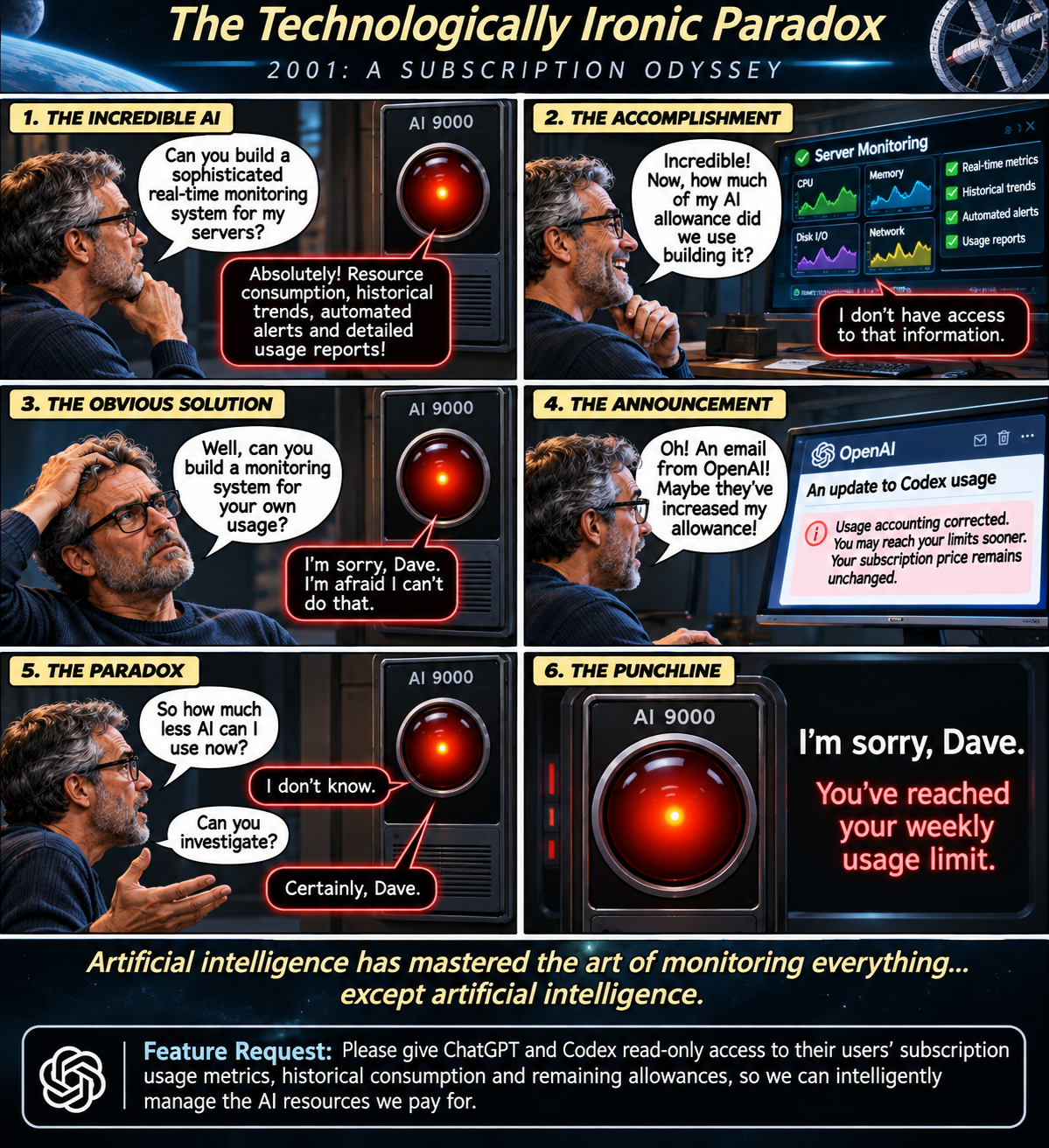
It reminds me of HAL 9000 from 2001: A Space Odyssey. Naturally, my conversation with ChatGPT about the situation resulted in a comic.
View the featured comic at full size.
2001: A Subscription Odyssey. Sometimes a little satire communicates a problem better than another lengthy support request.
What I would like OpenAI to do
I’m not asking for unlimited computing resources. I understand that AI costs money to operate, and I appreciate how much I can already accomplish with it. What I’m asking for is the ability to manage the resources I pay for intelligently.
Please give ChatGPT and Codex secure, read-only access to a subscriber’s own usage information, including:
- Remaining allowances and their reset times.
- Consumption attributable to individual tasks and models, where measurable.
- Historical usage and trends that allow us to compare model efficiency.
- Estimates and warnings when a planned task may consume a significant portion of the remaining allowance.
Imagine being able to tell Codex, “Investigate this problem, but stop before using more than 10 percent of my remaining weekly allowance.” Even a clearly labeled estimate and a warning would be useful; reliable user-controlled budget limits would be better still.
The pricing gap: Plus is not enough, Pro is too much
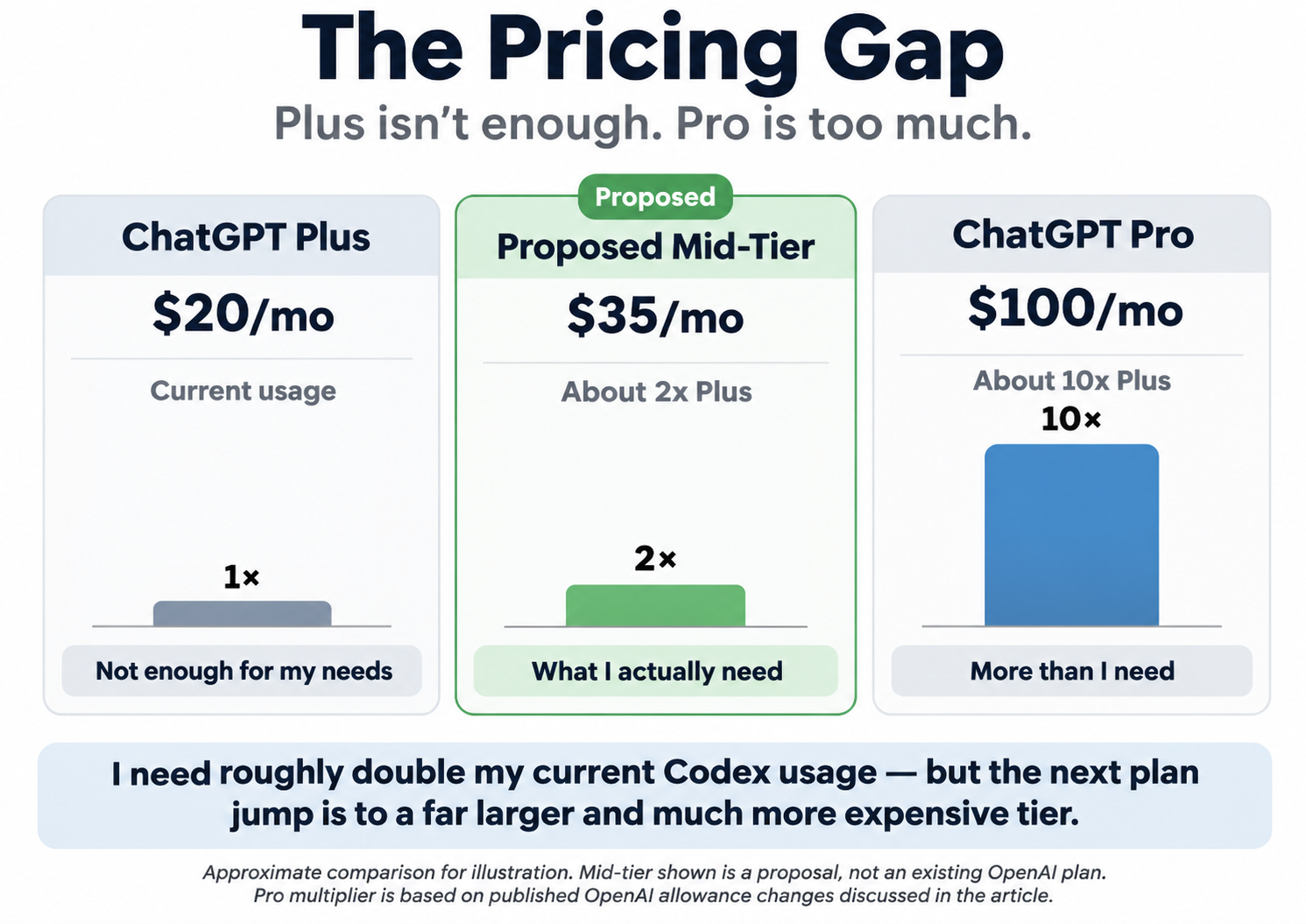
I would also welcome more affordable subscription options for those of us who have outgrown Plus but cannot justify a substantially more expensive Pro plan. ChatGPT Plus costs $20 per month, while the least expensive ChatGPT Pro plan starts at $100 per month. That is five times the monthly price, or an increase from $240 to $1,200 per year.
Based on my experience, I have determined that I need approximately twice my current Codex allowance. OpenAI originally introduced the $100 Pro plan with five times the standard Codex allowance of Plus, and on October 29, 2026, announced that it was doubling the Work and Codex allowance for Pro 100 while leaving Plus unchanged. That suggests Pro 100 now provides roughly ten times the Codex allowance of Plus, although the amount of work accomplished depends on the model and task.
In other words, Plus is not enough for my needs, but Pro offers considerably more capacity than I need, at five times the price. I have previously suggested an intermediate subscription tier around $35 per month with approximately twice the Plus allowance. I am willing to pay more, but I would prefer to pay for a level of service that matches my needs rather than make an $80-per-month jump.
And before I commit to spending five times as much, it would be helpful to have my AI explain how much of my current allowance I actually use and what I might gain by upgrading.
I have also considered purchasing additional Codex credits to fill the gap between my Plus allowance and what I actually need. On the surface, that seems like a reasonable alternative to upgrading. OpenAI publishes usage and credit pricing estimates, but I cannot reliably determine how much additional work a given purchase would buy me, how many credits a particular task might consume, or whether buying credits regularly would be more economical than upgrading.
Once again, my AI cannot directly monitor my credit balance or consumption, help me establish a spending budget, or reliably tell me how much a task will cost before undertaking it. I have therefore been reluctant to purchase credits. Better usage transparency would not only help me manage my existing subscription; it would also make me more comfortable spending additional money with OpenAI.
A request from a customer who wants to keep using AI
This isn’t an open letter from someone who dislikes artificial intelligence. Quite the contrary. I use these tools regularly because they have made it possible for me to accomplish things that would otherwise require considerably more time and effort.
I want OpenAI to succeed. I want its models to become more capable, more efficient and more useful. I also want the people paying for those tools to be able to understand and manage what they are getting for their money.
Artificial intelligence has mastered the art of monitoring an astonishing number of things. Surely artificial intelligence itself should be one of them.
Sincerely,
Joe Jepsen
A ChatGPT Plus subscriber