I’d Gladly Pay for Your Software. Just Not at Those Prices.

When did every useful piece of software become another expensive annual subscription?
I run several websites, and over the years I’ve discovered some genuinely excellent software: WordPress plugins, website management tools, security applications, SEO utilities, and programs that make operating my websites easier. I appreciate the developers behind them. Good software requires time, talent, and ongoing maintenance, and those developers deserve to be paid. But software pricing often seems aimed at operations much larger than mine.
Here’s the problem: I’m willing to pay. But apparently, I’m not the customer they’re pricing for.
I’m not opposed to subscriptions. I pay $20 a month for ChatGPT Plus, which I use for writing, research, programming, and website management. I also paid $99 for an entire year of WPVibe, which lets my AI tools interact with my WordPress websites. That’s $8.25 a month for a tool I can use across multiple sites. To me, that’s a reasonable investment.
I’m also paying for hosting, website backups, domains, email delivery, and the rest of the infrastructure. Those bills arrive whether my websites make a dollar or not. I’ve written about moving my websites from shared hosting to a VPS with help from AI. I know what it costs to keep them running, and I have to think carefully before adding another recurring expense.
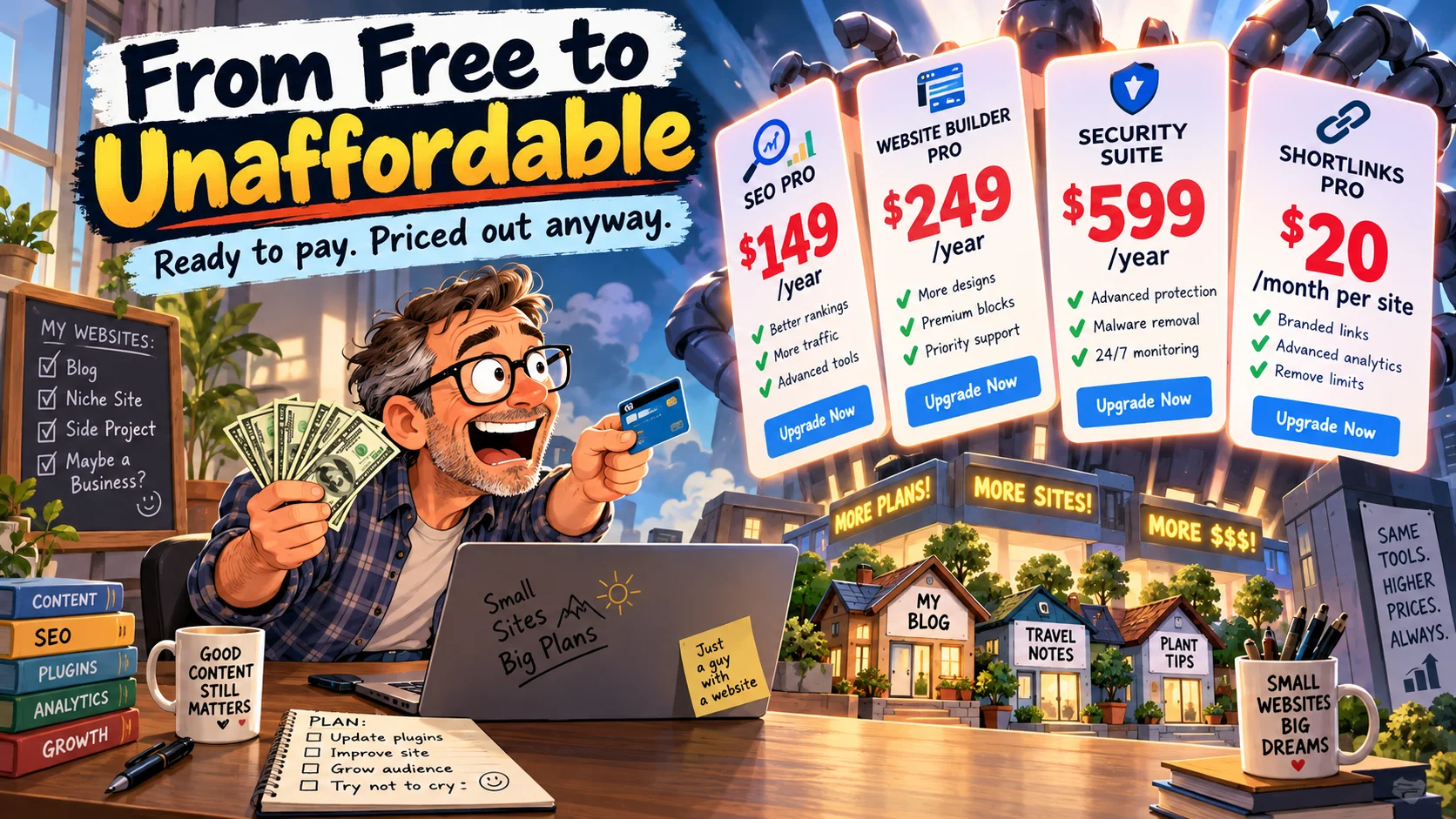
From Free to Unaffordable
Here’s an experience I’ve had more times than I care to count. I’ll be using the free version of a program and discover a feature that looks useful. I like the software, appreciate what the developer has created, and think an upgrade might be worthwhile. So I click the pricing link, and my immediate reaction is, “HOLY SHIT!”
Seriously, is that the reaction you want from someone who was just considering giving you money? I clicked because I was interested in buying the software, not because I expected it to be free. But when the first paid option costs $99, $149, or even $249 annually, my enthusiasm disappears rather quickly. It makes me question the marketing strategy.
There’s often an enormous gap between the free version and the first paid tier. Where’s the $20 feature upgrade, the $30 personal license, or the affordable option for someone who only wants one or two additional features? I don’t necessarily need agency tools, advanced analytics, priority support, and every feature the developer has ever dreamed up. Sometimes I want one capability that saves a little time.
Instead, the choice often feels like free software or a large commercial subscription designed for a business with a much bigger budget than mine. There’s an enormous missing middle between free and unaffordable.
When One Plugin Costs More Than My Hosting
Recently, I migrated 31 affiliate shortlinks from a self-hosted YOURLS installation to Pretty Links on one of my WordPress websites. Pretty Links is excellent, and its free version handled the job beautifully. I like being able to manage those links from the WordPress dashboard. Naturally, I looked at upgrading.
The introductory price for a single site was about $100 per year, but the listed regular renewal price was $249 annually. The five-site package listed a regular renewal price of $499 a year. Every. Single. Year.
My primary VPS hosting plan costs about $10 a month, or $120 annually before backups and other expenses, and it hosts several websites. One premium plugin can cost more than twice my entire annual base server hosting bill. I know that building software and hosting servers are different businesses, but that comparison still makes me scratch my head.

Photo: Jakub Zerdzicki / Pexels.
The funny part is that YOURLS is free and open source. It already gives me custom shortlinks, click statistics, an API, and an ecosystem of plugins. It does plenty of standalone link-management work without charging for a premium tier. The reason I switched wasn’t that YOURLS couldn’t do the job; it was the convenience of WordPress integration. I’d gladly pay a reasonable amount for that convenience. Just not hundreds of dollars a year.
Wordfence, Yoast, and Jetpack: Great Tools, Expensive Upgrades
Take Wordfence, which I use to help protect my WordPress sites against hacking attempts and malware. Its free version includes a firewall, malware scanning, and login protection. Premium adds real-time firewall-rule and malware-signature updates, a continuously updated IP blocklist, country blocking, and premium support. Those are meaningful improvements, especially when new vulnerabilities appear.
But Wordfence Premium costs $149 a year for one WordPress installation. Even with volume discounts, buying that protection across multiple sites adds up. I take security seriously—I even wrote about what happened when one of my websites got hacked—but I already use Cloudflare, Wordfence, server-level protections, and other safeguards. I have to evaluate whether another subscription for every site is the best use of my budget.
Then there’s Yoast SEO. The free plugin helps with titles, descriptions, readability, sitemaps, and other basics that help search engines understand a website. Premium adds internal linking suggestions, redirect management, AI-assisted optimization, and support. Those are useful conveniences, especially when a site has hundreds of articles, but Yoast SEO Premium is about $119 per year per site. Again, I may want one feature, not the whole package.
Jetpack takes the bundling approach even further. It offers website backups, malware scanning, spam protection, statistics, performance tools, social sharing, video hosting, and more. Some services are free, and to Jetpack’s credit you can buy narrower products. But the Complete package lists a regular price equivalent to $49.95 per month when billed annually—nearly $600 a year for one website.
I’m already paying for backups, and I already have security and performance tools. Would I use some Jetpack features? Sure. Does that mean I should pay for an entire premium suite that overlaps with services I already have? Not a chance.
SEO Software: Big Prices for Small Operations
The same pattern appears outside WordPress. Screaming Frog SEO Spider crawls websites and finds technical problems such as broken links, redirect chains, duplicate titles, and missing descriptions. Its free version crawls up to 500 URLs at a time, which is useful for smaller sites. The paid version removes that limit and adds advanced features, but costs $279 annually in the United States. At least that license is per user, not per website.
Ahrefs offers keyword research, backlink analysis, competitor research, rank tracking, and site auditing. It has free tools and a limited $29 monthly Starter option, which I appreciate, but its Lite package is $129 a month, or $1,548 a year. Semrush offers a similarly comprehensive professional toolkit. Its entry SEO package works out to about $117.33 per month when billed annually—more than $1,400 a year.
I recognize that Screaming Frog, Ahrefs, and Semrush are not interchangeable. Ahrefs and Semrush maintain large datasets for search and backlink research that I couldn’t reproduce by simply running a script. For a marketing agency or a large online business, their tools can be worth every penny. But what if I mainly want to catch broken links, fix metadata, inspect sitemaps, and improve internal linking on my own sites?
We can do a lot of that ourselves with free tools and the AI services I’m already paying for. ChatGPT and Codex can help me analyze WordPress content, audit the technical basics, identify linking opportunities, and automate some routine checks. I would still prefer polished, maintained software that saves time. But paying professional SEO-suite prices for occasional tasks makes little sense for a small operation.
Speaking of small operations, Lando Calrissian had a line in The Empire Strikes Back that always stuck with me:
“You see, since we’re a small operation, we don’t fall into the jurisdiction of the Empire.”
I’m not running Cloud City, and I certainly don’t have an Imperial-sized marketing budget. I’m managing a handful of independent websites. I don’t need every professional SEO feature in the galaxy; I need affordable tools that solve the problems in front of me.
Cloudflare and the Cost of Multiple Websites
I use Cloudflare across my sites and genuinely appreciate its generous free service. It helps with DNS, content delivery, HTTPS, and protection against malicious traffic. Would I like to try Pro for its additional security and performance capabilities? Absolutely. But at $20 a month per domain with annual billing, six separate domains would cost $120 per month, or $1,440 a year.
Easy Digital Downloads presents another dilemma. It helps WordPress owners sell ebooks, software, and other downloadable products. There’s a free version, while the paid packages provide more advanced sales and marketing features. With regular annual prices starting around $199 and rising into the hundreds, it can be tough to justify the upgrade while you’re still experimenting with whether a digital product will sell.
I know a successful store or agency might recover those costs easily. Independent bloggers, hobbyists, and owners of smaller sites live with different financial realities. We’re potential customers, too.
Some Developers Offer Better Choices
I want to give credit where it’s due. MainWP, which I use to manage multiple WordPress installations, allows unlimited websites on its genuinely useful free tier. Its Pro subscription is $199 annually, but it also offers a $599 lifetime license. That’s a big upfront purchase, yet it gives customers an alternative to perpetual annual payments.
There are smaller-scale examples, too. Arigato PRO, a WordPress email autoresponder, has offered a one-time license with a year of updates and support, leaving continued maintenance as an optional purchase. I like that idea: the developer is paid for the program, the customer can keep using it, and ongoing support can still generate revenue.
And I keep coming back to WPVibe. I paid $99 for a full year, and its usefulness spans multiple WordPress sites and many different jobs. It’s not that every product needs to copy its pricing structure. Cloud services, security research, and large SEO datasets have real ongoing costs. But more than one kind of customer ought to be able to buy useful software.
AI Has Changed How I Buy Software
Here’s what developers might want to consider. When I find an expensive upgrade, I now ask ChatGPT whether I actually need it. Not whether the product is good—many of these products are excellent—but whether I can accomplish the task with tools I already have. Surprisingly often, the answer is yes.

Photo: Daniil Komov / Pexels.
I was seriously considering buying Link Whisper to improve internal linking across my sites. But the plan I was considering would cost $197 per year for three websites and included only 3,000 AI credits. That’s nearly $200 every year for another tool with usage limits, on top of the subscriptions I already pay for. Before making the purchase, I asked whether ChatGPT, Codex, and WPVibe could handle the job. We found an approach that could examine my existing articles, propose relevant links, and make changes in WordPress. I actually preferred the control it gave me over which links to add. No additional subscription, plugin, or middleman was necessary for my purposes.
Then there was an image-optimization plugin that would convert a small number of pictures to WebP for free but wanted money once I needed more. WebP can reduce image file sizes and improve load times, so the job was worthwhile. Instead of buying another service, we used existing tools and did the conversions ourselves. Problem solved without another subscription.
This has become a pattern: discover a useful feature, click Upgrade, see the price, and ask AI about alternatives. Sometimes another free application does the job. Sometimes there’s an open-source utility. Sometimes Codex helps build a small solution suited to my sites. I was willing to pay for Link Whisper. Had a modestly priced option met my needs, I might never have investigated alternatives. The same goes for image conversion.
Developers aren’t only competing with other commercial products anymore. They’re also competing with free software and customers who now have AI helping them solve their own problems. A price that drives someone to explore alternatives can end up eliminating the need for the product altogether.
I’d Rather Pay Than Reinvent the Wheel
I want software developers to understand that I would actually prefer to buy your software. I don’t enjoy reinventing the wheel. If a program already does what I need, stays updated, runs automatically, and saves time, that convenience is worth paying for. I’d much rather have an established developer maintaining it than spend an afternoon troubleshooting a custom script. My time has value, too.
But the price has to be reasonable relative to the benefit. I might happily spend $20, $30, or $50 for a feature that occasionally saves me an hour. Paying $150 or $250 every year for that same convenience is another matter, particularly when I already subscribe to multipurpose tools that can help me do the work.
Doing it yourself is not automatically better. Custom scripts need testing, maintenance, and occasional repairs. Commercial software provides real value through reliability, support, and ongoing development. I’d rather pay a reasonable price and get my time back. When that option doesn’t exist, however, doing it myself becomes the sensible choice.
Why Leave Money on the Table?
Suppose I love your free program and would gladly pay $25 to unlock one feature, but the only option costs $149 annually. I won’t buy it. You could have made $25 from me, but instead you made nothing. How many other small website owners make the same decision?
I’m aware that additional tiers create complexity and cheap plans might cannibalize expensive ones. Maybe the companies have studied this and concluded that their current pricing is more profitable. I don’t know their financial numbers, and I’m not claiming otherwise. But from my perspective, there appears to be a group of potential paying customers stuck between free and a large commercial subscription.
Keep the agency packages. Keep the professional suites. Charge what makes sense for the customers who need everything. Just consider an inexpensive personal license, a small feature upgrade, or a one-time purchase with optional paid maintenance for customers who need less.
When somebody clicks Upgrade, you’ve already convinced them that your software is useful and they want more of it. If the next step is “Holy shit!” followed by a search for alternatives, something in that sales process deserves a closer look. You’ve turned a potential sale into a research project for your competition.
I Want to Be Your Customer
I run my websites because I enjoy building things, sharing information, trying ideas, and occasionally making a little money along the way. I already invest in hosting, backups, domains, email, and software that genuinely helps me. I’m not asking developers to work for free, provide lifetime support without compensation, or cut prices for customers who need professional capabilities.
I’m asking them to recognize the difference between somebody who wants every feature and somebody who wants a few conveniences. With AI making alternatives easier to find and use, overpriced software can push potential customers toward competing solutions. And once they’ve found an alternative that does everything they need, what reason do they have to come back?
The longer I have to think about whether your subscription is worth the money, the more likely I am to discover I don’t need it at all. I didn’t start out trying to avoid paying software developers. I started out wanting to buy their software.
I was ready to give them my money. Their pricing encouraged me to figure out how to keep it. I don’t want everything for free. I want the opportunity to pay a fair price for what I actually need.
I want to be your customer. You’re making it awfully difficult.