Where My VPS Actually Lives — and the Nuclear-Powered One I Want (Part 2)

Once I had my VPS running, I made the mistake of asking a simple question:
Where does this thing actually live?
That question sent me down an entirely different rabbit hole.
Part 1 of this story was about leaving shared hosting, learning to manage a VPS, discovering Nginx is pronounced “Engine X,” building backups, and realizing that AI had made server administration manageable for me.
If you haven’t read Part 1, you can start there.
This part is about the physical Internet: the buildings, power systems, fiber, backup locations, and ultimately the nuclear-powered VPS I now wish existed in Oak Ridge, Tennessee.
My VPS Lives at a Former Military Intelligence Site
We talk about “the cloud” as if our data floats around in the atmosphere somewhere.
It doesn’t.
My VPS is a virtual machine, but underneath that virtualization is a real computer sitting in a real building connected to real power lines and fiber-optic cables.
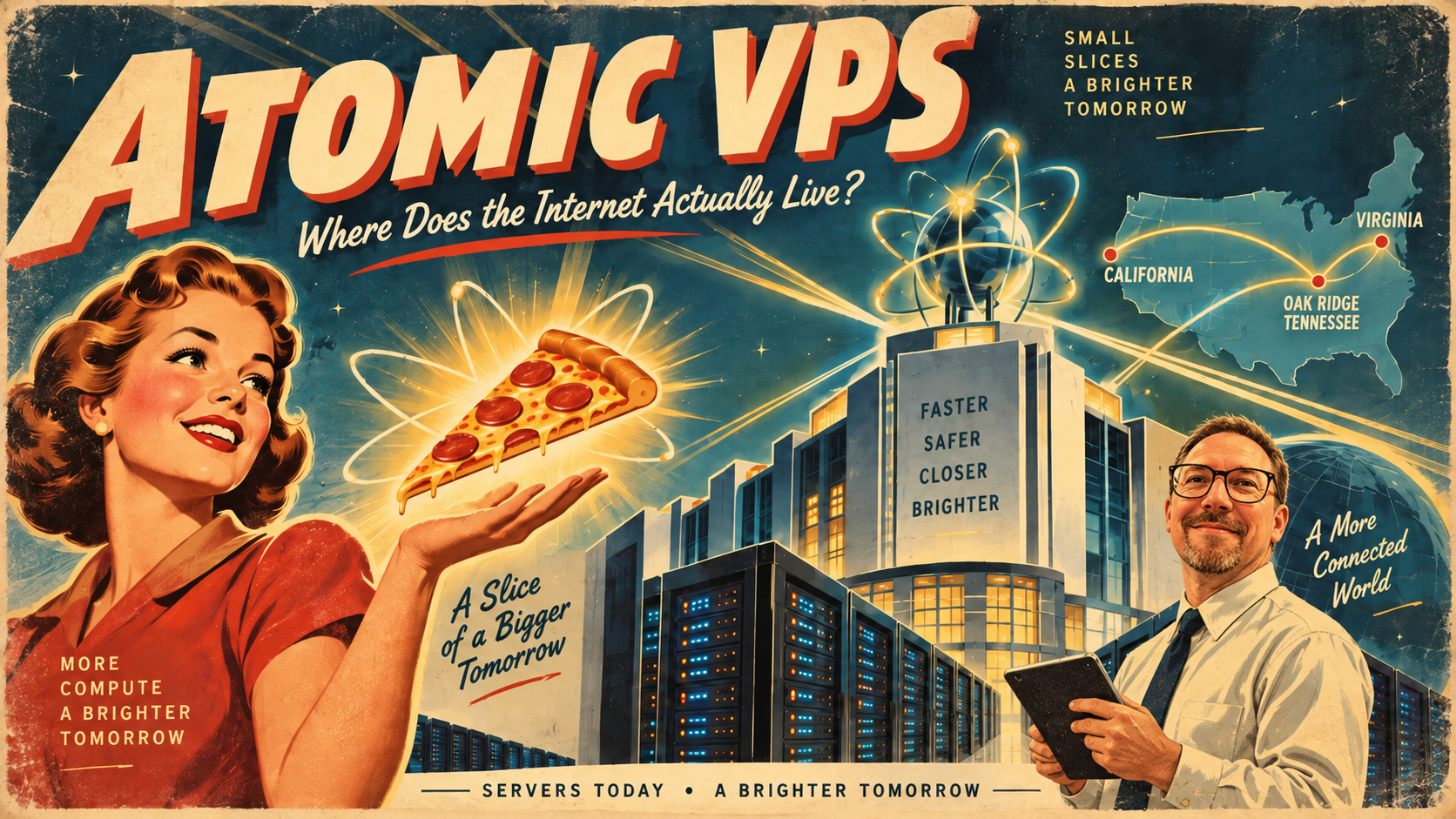
I chose OVHcloud’s Virginia region for my production VPS.
Then I discovered where the Virginia facility is:
Vint Hill, Virginia.
And Vint Hill has a fascinating history.
According to the Virginia Department of Historic Resources, Vint Hill Farms Station was established in 1942 as a U.S. Army intelligence operations and monitoring station. Personnel there intercepted and decoded communications during World War II, and the site continued serving intelligence functions during the Cold War before closing in 1997.
Today, OVHcloud lists Vint Hill as its Washington, D.C.-area data-center region.
So my little VPS pizza lives at a former military intelligence site.
That is considerably cooler than I expected when I clicked “Virginia” on the location menu.
The Second Copy Belongs in El Segundo
Running my own VPS also changed the way I think about backups.
When shared hosting handles everything, it is easy to think of backups as another button somewhere in the control panel.
When you are responsible for the server, backups become considerably more personal.
I wanted a local recovery option, but I also wanted an independent copy somewhere else.
Not another directory on the same machine.
Not even another server in the same building.
A different provider in a different part of the country.
That brought me back to InterServer, the company whose “VPS slices” helped inspire my pizza analogy in the first place.
I didn’t choose InterServer for the production server, but its inexpensive storage VPS made a lot of sense for off-site backup storage.
I put that backup on the West Coast in the Los Angeles area, in El Segundo, California.
“El Segundo” literally means “the second.”
My second copy lives in The Second.
Sometimes the universe writes its own documentation.
There is also a serious reason for putting it across the country.
My production server is in Virginia. If there were a major regional outage affecting the East Coast, the backup would remain thousands of miles away under a different company’s infrastructure.
If California has a problem, the production sites continue running in Virginia.
No location is immune to trouble. The idea isn’t to find a mythical place where nothing bad can happen.
The goal is simply not to put every egg in the same basket.
Data Centers Are Much More Ordinary Than I Expected
One of the stranger parts of this research was looking at data centers on maps.
Before this project, I had a vague mental image of them as enormous secret complexes sitting alone behind fences somewhere far away from normal life.
Some are like that.
Others really aren’t.
Looking at the Los Angeles-area backup location from above, I was surprised by how ordinary the surrounding area looked. There were businesses and restaurants nearby, major roads, and residential areas not terribly far away.
There was even a Chick-fil-A nearby.
From the outside, most people driving through the area would probably never realize there was a data center there.
I could see a row of what appeared to be large backup generators outside the facility. In my head they immediately became fusion-core reactors.
They are almost certainly much less exciting than that.
But I had already gone too far down the rabbit hole.
Data Centers Aren’t Optional Infrastructure
There is a growing backlash against AI and the data centers being built to support it.
Some of the concerns are legitimate.
Data centers can use enormous amounts of electricity. Some cooling designs use significant amounts of water. Very large projects can affect local power planning, utility infrastructure, land use, noise, and surrounding communities.
If a data center uses electricity and water, it should pay its share. Communities should not be expected to quietly absorb the cost of infrastructure required by a giant private development.
But that is very different from pretending data centers themselves are optional.
AI may be driving the latest construction boom, but data centers were not invented for ChatGPT.
They are the physical infrastructure behind modern digital life.
Streaming video, online shopping, banking, cloud storage, business websites, social media, email, online games and software updates all have to run on computers somewhere.
Your cell phone depends on data centers too.
Think about everything your phone does beyond making a basic voice call: messaging, maps, photo backup, authentication, streaming, app data, social media, banking and cloud services.
Those services do not live inside the phone.
Netflix does not float around in “the cloud.”
Amazon is not powered by magic.
The cloud is somebody else’s computers sitting in buildings full of servers.
One criticism I have heard is that today’s data centers are much larger than the facilities we built years ago.
Of course they are.
Grocery stores became supermarkets and then supercenters. Warehouses became distribution centers. Telephone systems grew from local switchboards into massive communications networks.
Infrastructure tends to get larger when more people use it and expect it to do more.
The Internet has followed the same pattern.
Twenty years ago most households were not streaming several televisions, continuously backing up thousands of photos, operating businesses in the cloud, video calling relatives, running smart homes, streaming music everywhere, doing nearly all of their banking online, and asking AI systems questions throughout the day.
We cannot continually demand more from the Internet while insisting that the physical infrastructure behind it remain the same size it was when our demands were smaller.
That does not give large data-center projects a free pass.
The reasonable question isn’t whether data centers should exist.
It is:
How do we build the data centers we need in a way that is reliable, efficient and responsible to the communities that host them?
I am unapologetically pro-data-center. Reason made a similar case in “The Joys of Data Centers.”
I am also pro-making them pay their own way and pro-holding them accountable for how they use resources.
Those positions are not contradictory.
Then I Started Thinking About Oak Ridge
After researching Virginia and California, another question occurred to me:
Why don’t I have a server in Oak Ridge, Tennessee?
It’s Oak FREAKING Ridge. The Secret City. The Manhattan Project. Oak Ridge National Lab. Supercomputing.
If I am going to rent a little slice of the Internet somewhere, obviously I want the nuclear-powered version.
And the funny part is that the idea is not completely ridiculous.
In July 2025, the U.S. Department of Energy selected the Oak Ridge Reservation as one of four federal sites to move forward with plans for private-sector AI data-center and energy-generation projects.
Then, in September 2025, DOE formally sought proposals from companies interested in building and powering AI data centers at Oak Ridge.
Two potential areas were offered, including land adjacent to Oak Ridge National Laboratory.
DOE’s planning material identified a potential 562-acre development area, about 100 acres of near-term development space, and nearby 500-kV electrical transmission infrastructure.
In other words, somebody at the Department of Energy apparently looked at Oak Ridge and had roughly the same thought I did:
This seems like a logical place to put a lot of computers.
Oak Ridge Already Knows a Little About Big Computers
Of course, Oak Ridge is hardly new to serious computing.
Oak Ridge National Laboratory has spent decades operating some of the world’s most powerful scientific computing systems.
And in February 2026, ORNL launched its Next-Generation Data Centers Institute.
The institute focuses on issues including power-system architecture, cooling, grid integration, security, load management and the practical infrastructure required by increasingly large AI data centers.
So Oak Ridge is not merely a place where somebody could study this problem.
It is literally studying how the next generation of data centers should work.
This is where my wish list begins getting dangerous.
I Want the Nuclear-Powered VPS
If my server is sitting in Oak Ridge on TVA power, I’m calling it nuclear powered.
TVA is also actively exploring advanced nuclear development at its Clinch River Nuclear site near Oak Ridge. The site has federal approval for the potential construction and operation of small modular reactors with total generation of up to 800 megawatts.
I May Have to Wait for My Nuclear-Powered VPS
The important distinction is that Oak Ridge getting major data centers and Oak Ridge getting the kind of ordinary commercial hosting where I can click a button and rent a $10 VPS are two different things.
The first is already moving from idea toward real development.
The second may take years.
Large AI facilities, national-laboratory computing and energy research do not automatically create the same retail hosting ecosystem that exists around major commercial data-center markets such as Northern Virginia and Los Angeles.
Maybe five or ten years from now somebody will finally put up the page I want to see:
Oak Ridge, Tennessee — VPS from $10/month.
If they do, I am clicking Buy before they finish loading the page.
Until then, my production server will remain in Virginia, my independent backup will remain on the other side of the country, and my hypothetical atomic VPS will remain on the wish list.
But after everything else that happened while I was learning to run this server, I have learned not to rule anything out.
I had already joked that if we kept adding redundant pathways and self-correcting subroutines to this project, we might accidentally invent time travel.
Now I am asking for a server in Oak Ridge with nuclear power and 1.21 gigawatts.
At this point, if I accidentally invent time travel while configuring WordPress, I’m calling it a feature, not a bug.
And if that happens, I know exactly where I’m going first.
I’m going back to buy Bitcoin when it was cheap.
I had spent all this time thinking about where my VPS lived, how it was backed up, and how much more control I had over my websites.
There was still one question sitting quietly in the back of my mind:
What happens if I get hacked?
I did not have to wonder very long. Then I got hacked.