A $5,000 Trump Dividend? I Have a Better Idea

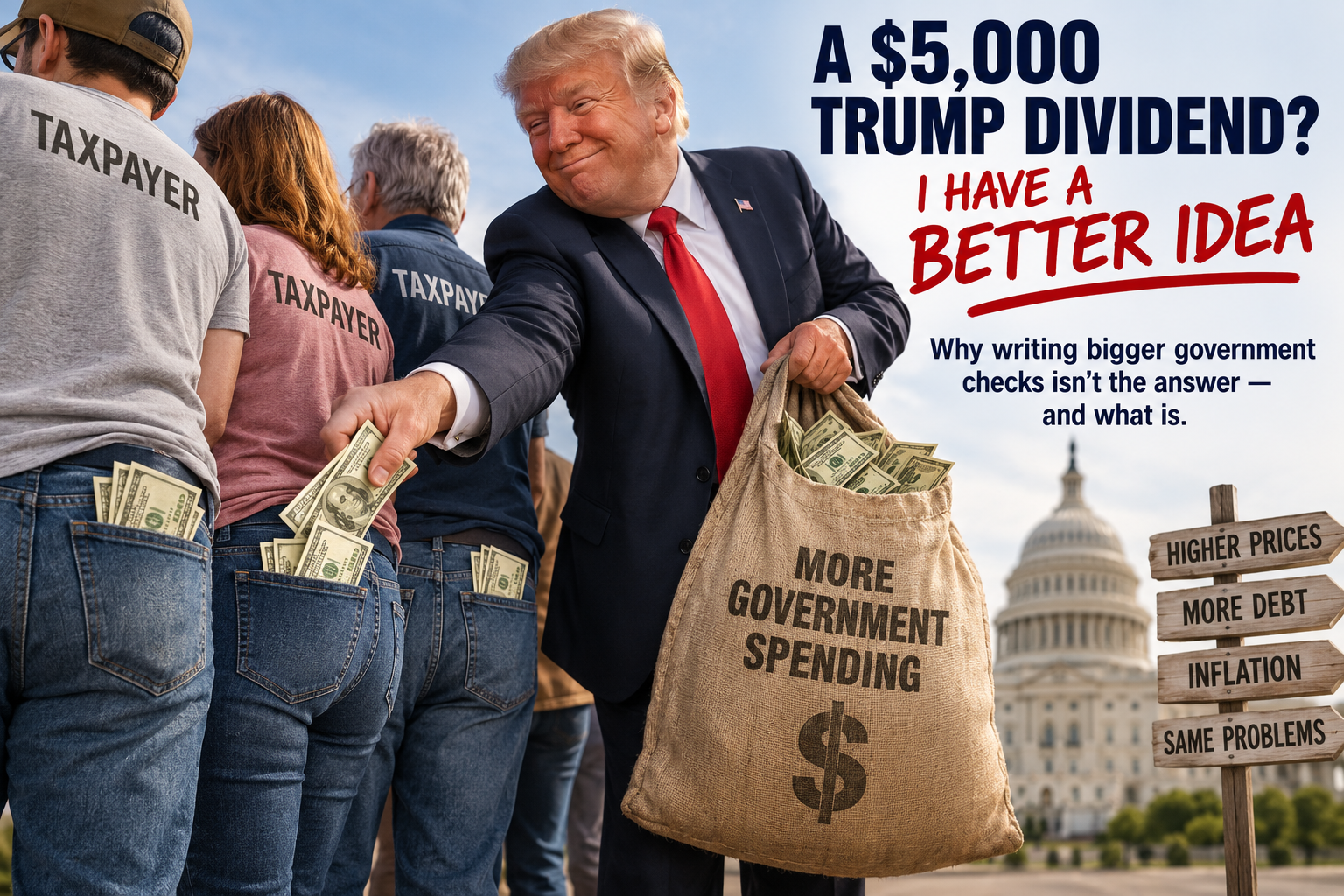
President Trump has proposed giving every adult American citizen a $5,000 “Trump Dividend” if Republicans retain control of both the House and Senate in the 2026 midterm elections.
I have a problem with that.
And before anyone reaches for the tired “Trump Derangement Syndrome” argument, let me make something clear: I am not opposed to everything Trump does. There are policies and goals of his that I agree with. There are other times when I agree with what he is trying to accomplish but strongly disagree with how he goes about accomplishing it.
This is one of those times when I think we should be asking some very basic questions.
Starting with the trillion-dollar one:
Is Trump going to pull this money out of his ass?
The Associated Press reports that sending $5,000 to every adult American citizen would cost more than $1 trillion. Trump has not provided a detailed funding plan, and the payment would require congressional approval. Vice President JD Vance has suggested tariff revenue could help pay for it, but that revenue would fall far short of the total cost.
Meanwhile, the Congressional Budget Office already projects that the federal government will spend about $7.4 trillion in fiscal year 2026 while collecting only about $5.6 trillion.
That leaves a projected deficit of approximately $1.9 trillion before we start mailing anybody another $5,000. Debt held by the public is projected to reach $32.1 trillion by the end of the fiscal year, while total gross federal debt is already around the $40 trillion neighborhood. See the CBO budget outlook.
So unless Washington suddenly discovers a trillion dollars stuffed between the cushions of the Oval Office sofa, the obvious question remains: are we simply going to borrow most of it?
Let’s just say my colorful accounting method is directionally correct.
It Feels an Awful Lot Like Vote Buying
Legally, I am not claiming that Trump’s proposal constitutes vote buying.
That distinction matters.
Traditional vote buying involves giving or promising something of value in exchange for an individual’s vote. Under Trump’s proposal, the $5,000 would apparently go to eligible adults regardless of how any particular person voted, provided Republicans retained both chambers of Congress.
That is an important legal distinction.
But politically and ethically?
I am uncomfortable with it.
Trump’s pitch was remarkably direct: Republicans win Congress, and adults get $5,000.
That may not satisfy the legal definition of buying somebody’s vote, but it gets close enough to the spirit of the idea that I think Americans should at least be willing to discuss it without immediately retreating into partisan camps.
Imagine the exact same proposal coming from a different president—Obama, Clinton, or even Bush.
Would you still be comfortable with it?
That is usually a useful test.
Americans Have Bigger Problems Than Naming Things
The whole thing also bothers me because of where our political attention seems to be going.
In August, Trump issued an executive order directing the federal government to rename Lake Ontario “Lake America.” Read the executive order.
Yes, really.
Canada unsurprisingly still calls it Lake Ontario, a name that has existed for centuries.
Now, renaming a lake obviously isn’t responsible for the federal deficit. It isn’t the reason your grocery bill went up. It isn’t why housing is expensive.
But it does illustrate what frustrates me about Washington.
Americans are dealing with very real economic pressures.
The latest available Consumer Price Index data show overall prices were up 3.4% over the previous year as of July 2026. Food was up 3.0%. Shelter was up 3.2%. Electricity was up 4.2%. Natural gas service was up 4.3%. Gasoline was up 24.6%. See the Bureau of Labor Statistics data.
Those are things families notice.
People notice what it costs to fill the car.
They notice what leaves their checking account when the electric bill hits.
They notice when a cart full of groceries costs more than it used to.
They notice rent, mortgage payments, insurance and utilities.
Against that backdrop, I have trouble getting excited about renaming lakes and promising enormous government checks.
A $5,000 Check Doesn’t Fix the Underlying Problem
There is another uncomfortable issue here.
If the government borrows more than $1 trillion and distributes it to households, that doesn’t magically create $1 trillion of new wealth.
It redistributes purchasing power while adding another enormous federal obligation.
Government borrowing is not technically the same thing as the Federal Reserve “printing money,” and it would be inaccurate to claim that borrowing $1 trillion automatically reduces the value of every dollar by some fixed percentage.
Economics doesn’t work that neatly.
But deficits accumulate.
Debt accumulates.
Interest accumulates.
And inflation gradually reduces the purchasing power of money.
That cumulative effect matters.
It is one reason assets with limited or constrained supply—including gold, silver and Bitcoin—can look increasingly attractive to people trying to preserve purchasing power over long periods.
That does not mean those assets are guaranteed winners. Bitcoin can be extremely volatile. Gold and silver fluctuate too.
But every time Washington demonstrates that another trillion dollars of borrowing is politically easier than confronting structural fiscal problems, it makes the argument for scarce assets easier to understand.
Americans don’t need Washington to borrow $5,000 on their behalf, hand it back to them, call it a dividend and congratulate itself for helping.
So What’s the Alternative?
This is where political criticism too often ends.
Someone identifies a problem, complains about it for 1,500 words, insults the opposing political tribe and goes home.
That isn’t particularly useful.
If I’m going to criticize this proposal, I should offer an alternative.
Mine is the FairTax.
The FairTax Act of 2025, H.R. 25, was introduced in the House and referred to the Committee on Ways and Means. It would replace federal individual income taxes, corporate income taxes, payroll taxes, estate taxes and gift taxes with a national retail sales tax on new goods and services.
Instead of taxing what people earn, save and invest, the federal government would primarily tax consumption.
Households would receive a monthly “prebate” intended to offset the tax on spending up to the poverty level.
And yes, we need to talk honestly about the rate.
The famous FairTax number is 23%.
That is a tax-inclusive rate. Expressed the way Americans normally think about sales taxes—added to the pretax price—it is approximately 30%.
Critics argue that even that rate may not currently generate enough revenue to replace all of the federal taxes the FairTax proposes to eliminate.
That’s a legitimate question.
But it leads directly to another one that I think is considerably more important:
How much government are we trying to fund?
When earlier versions of the FairTax were developed, federal spending was significantly smaller.
Today CBO projects federal spending equal to 23.3% of GDP, compared with a 50-year average of 21.2%. CBO expects large deficits to continue and projects debt held by the public rising from 101% of GDP in 2026 to 120% by 2036.
If government becomes more expensive, the tax required to finance that government also becomes more expensive.
That isn’t automatically a flaw in the method of taxation.
It may be a flaw in the amount of government we’re trying to pay for.
Tax Consumption Instead of Productivity
This is ultimately why I continue to like the FairTax concept.
I would rather tax consumption than punish work, saving and investment.
Under our current system, the federal government takes a portion of your paycheck before you ever receive it. Businesses pay income taxes. Workers and employers pay payroll taxes. Investment gains can be taxed. Estates can be taxed.
The FairTax takes a fundamentally different approach: earn your money first, then pay federal tax when you choose to consume.
Make the Taxes Visible
There is another reason I support the FairTax that doesn’t get nearly enough attention: it makes federal taxation transparent.
I want Americans to see what their federal government costs them.
Under the FairTax, the federal tax would be right there when you make a purchase. No pretending that the employer’s share of payroll taxes somehow doesn’t affect workers. No hiding part of the government’s cost inside corporate taxes and then acting surprised when taxes ultimately affect wages, investment or prices. You would be able to see the federal government’s cut.
I think that transparency would change the political conversation.
It becomes much harder for politicians to promise us “free” money when taxpayers can clearly see where government money comes from in the first place.
That brings me right back to Trump’s proposed $5,000 dividend—and to the idea of tariff refund checks.
Tariffs aren’t free money from foreign countries. They are taxes collected by the United States on imported goods, paid initially by American importers, with at least part of the economic burden potentially reaching American businesses and consumers.
So I’m not particularly interested in Washington collecting more money through tariffs and then offering to give some of it back to me as a refund or dividend.
I’d rather keep more of my own money in the first place.
A transparent tax system makes that relationship harder to disguise. When government wants another dollar, Americans should be able to see that dollar being taken. And when a politician subsequently promises to give us money, we should remember whose pocket it came from.
I would also like to see most tariffs eliminated. If we’re serious about taxing consumption transparently, we shouldn’t simultaneously hide additional taxes inside the prices of imported goods.
That, to me, is a much healthier relationship between citizens and government than politicians collecting taxes indirectly and then competing to see who can offer us the most attractive check.
There are legitimate arguments about the transition, revenue neutrality and the appropriate rate. Any serious FairTax discussion should acknowledge those issues rather than pretending they don’t exist.
But collection itself is not some exotic new mechanism. The FairTax would be collected at the point of sale in much the same way state and local sales taxes are collected now.
And I think there’s another problem with the way this debate is often framed.
Too many criticisms of the FairTax examine every possible weakness in the proposal while quietly assuming the current tax system is the better alternative.
That comparison is backwards.
The FairTax should not be measured against a perfect tax system that does not exist. It should be measured against the complicated, distortionary system we actually have today.
The relevant question isn’t whether I’d rather pay a national sales tax or pay no taxes at all.
It’s whether I’d rather finance the federal government through a consumption tax or continue financing it through the combination of income taxes, payroll taxes, corporate taxes, estate taxes and the enormous bureaucracy required to administer the current system.
I know which system I prefer.
And those are debates worth having about how we structure and finance our government.
“Vote for our party and you might get a $5,000 check” is not tax reform.
This Doesn’t Have to Be Republican Versus Democrat
One of the worst habits in American politics is the assumption that criticizing a politician means joining the opposing team.
I don’t particularly like either team.
I can support something Trump does on Monday and criticize something he does on Tuesday.
That shouldn’t be controversial.
Citizens of a constitutional republic aren’t supposed to surrender independent judgment because their preferred politician—or the politician they dislike less—currently occupies the White House.
Trump has often challenged conventional assumptions about what the federal government and presidency can do. Sometimes those challenges produce policies I agree with. Sometimes I agree with the objective and dislike the method.
Sometimes, as with this proposal, I think the entire priority is misplaced.
There are enormous structural issues sitting in front of us: federal spending, taxation, debt, purchasing power, housing affordability, energy costs and the long-term sustainability of our fiscal system.
Those issues deserve serious political capital.
I’d rather see a president spend that capital trying to reform the tax code and rein in spending than renaming bodies of water and dangling trillion-dollar “dividends” in front of voters.
Keep the $5,000.
Give me serious tax reform, responsible spending and a dollar that still buys something ten years from now.
Want to Learn More About the FairTax?
Don’t take my word for it. See how the FairTax works, what taxes it would replace, and how the monthly prebate works.